A website for your waste firm, built before you pay for it.
I build websites for waste carriers, skip hire and recycling firms in Worcestershire and across the UK. Every stream on its own page, your registration and permit numbers where a customer can check them, and a form that asks what you need to price a collection. I build yours first, finished: £650 if you want it, a written quote first if it needs to be bigger, and nothing if you don’t.
£0 to see it finished
£650 for the website
Or WhatsApp me One message is enough to start.
 I’m Archie Spencer. I build every site myself.
5.0 on Google from 4 reviews. Read our reviews on Google (opens in a new tab)
“It's clean, looks professional and is easy to find your way around, which is exactly what I wanted.”
Real sites, live now. Open any of them.
There is no waste firm among my live sites yet. That is why yours is built first: you judge your own site, not a promise. The nearest match is HERU, where every line follows agreed terminology with legal considerations behind it, and still reads plainly.
-
Livemyheru.com
HERU
Building infrastructure, Bidford-on-Avon
-
Livestratworthadvisory.com
Stratworth Advisory
Exit planning and growth advisory, Bidford-on-Avon
-
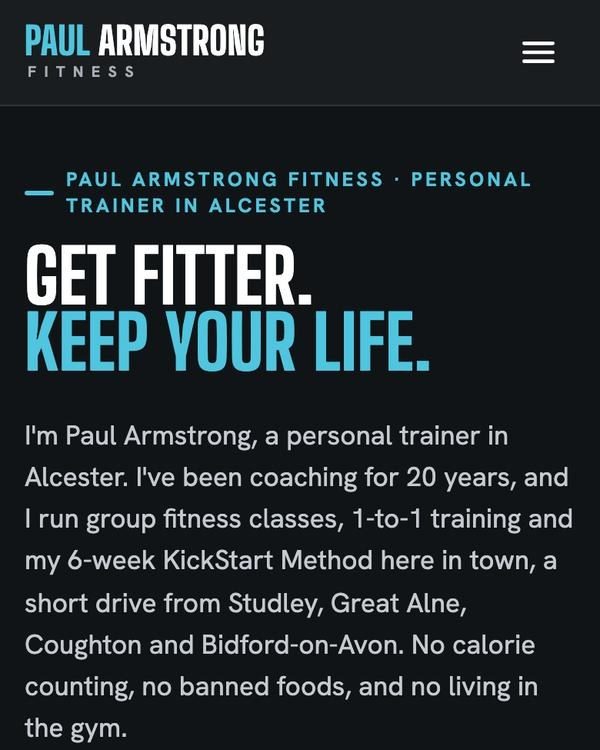
Livepaularmstrongfitness.co.uk
Paul Armstrong Fitness
Personal trainer, Alcester
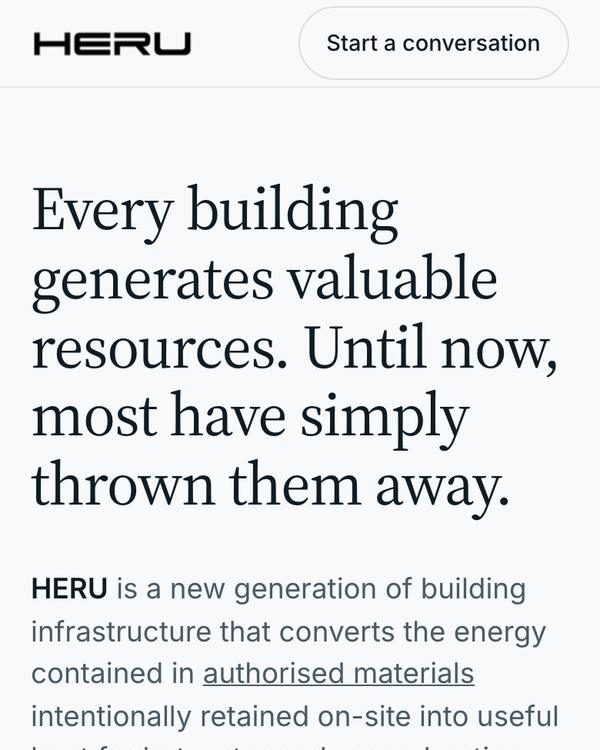

“We therefore had detailed legal and regulatory considerations behind the terminology used throughout the website.”
Read it in full
Archie recently designed and built the new website for HERU Technologies, and I was extremely impressed by both the quality of the finished site and the way he approached what was a surprisingly complex brief.
One of the biggest challenges was language. HERU operates in an area where the distinction between an authorised material intentionally retained for a further purpose and something simply discarded can be important. We therefore had detailed legal and regulatory considerations behind the terminology used throughout the website. At the same time, we absolutely did not want the site to read like a legal or technical document.
Archie understood that challenge very quickly. He worked through the wording, structure and user journey so that a first-time visitor can understand what HERU is and what it does, while ensuring that the terminology remains disciplined and consistent throughout the site.
That balance between simplicity for the visitor and complexity behind the scenes was, for me, one of the strongest aspects of his work. He didn’t simply build what we asked for; he understood the problem we were trying to solve and designed the website around it.
The result is a website that represents HERU far better: clean, contemporary and easy to navigate, but with considerable thought behind what appears on the surface to be very simple communication. I would have no hesitation recommending Archie for a business looking for someone who can combine web development with genuine problem-solving.
I’ll build it first. You decide after.
Tell me the firm’s name, the streams you take and the area you cover. I send you three homepage designs within a day, then build the whole website in the one you pick, every page written, usually in about 2 days, and send you a link. Look at it in your own time, and show the owner and anyone else with a say.
If you want it, it’s £650: a £162.50 deposit once you’re happy with the design, and the rest within 7 days of it going live. A bigger site, built around stock, listings or several locations, is quoted in writing before I build. If you don’t want it, say so and it comes down. You pay nothing, and I won’t follow it up.
For the owner
- Your domain (your web address, like yourbusiness.co.uk) is bought in your name, on your card. About £10 a year, paid to the company you buy it from, not to me. I send you a one-page guide to buying it.
- Already have a domain? The new site goes live on it, and your email is not touched.
- Every login is handed over in writing once it is paid for, and the hosting moves to an account in your name at no cost. Nothing is locked to me.
- No monthly fee unless you choose monthly care: £29 a month for up to five changes, stop any time.
- If you change your mind after saying yes, the 25% is kept for the work done. If I can’t get it live for a reason on my side, it comes back in full.
- You pay by bank transfer to the account named on the invoice. My bank details will never change by message.
- Your business information is kept confidential and used only to build your website. The full terms are on this site.
Already have a website? When I rebuilt Stratworth Advisory’s website, I measured both home pages the same way on the same day: the old WordPress one took 7.4 seconds to show its main content, the new one 0.8 seconds. How it was measured
What waste and recycling firms need from a website.
Your registration and permit numbers, in text, where they can be checked
A customer choosing a carrier is buying protection from their own liability. Under section 34 of the Environmental Protection Act 1990 the producer stays responsible for their waste long after it has left the yard, so a careful buyer checks you before they book anything. Put the carrier, broker and dealer registration number on the page as plain text, with the permit numbers for the sites you tip at, and say where it can be checked: the Environment Agency’s public register, or SEPA, Natural Resources Wales or the NIEA depending where you are registered. A number sitting inside a logo image cannot be copied into that search. One that can be is the shortest route from enquiry to order.
A page for each waste stream, because each one is a separate search
General and trade waste, dry mixed recycling, food waste, hazardous, clinical, WEEE, confidential shredding, construction and demolition. Nobody searches for “waste management”. They search for “food waste collection Redditch” or “confidential shredding Worcester”, and one services page listing nine streams in a row appears for none of them. A page each also lets you say the things that actually differ: container sizes, what can and cannot go in, how the material is coded and who signs for it. The customer booking a clinical collection is not the customer booking a grab lorry, and neither should have to read the other’s page to find two lines about their own.
A route for an existing customer to get their own paperwork back
Transfer notes have to be kept for two years and hazardous waste consignment notes for three, and the customer holds a copy as well as you. So when an auditor, an insurer or a new facilities manager asks for last year’s, they ring you. Say on the site exactly how that works: who to email, what to quote, how long it takes. If you already issue tonnage and destination reports, show a sample with the customer’s name taken off. Large customers are pulling those figures into their own carbon reporting now, and the firm that hands them over in a usable format is the one that keeps the contract.
Enough on price to be worth ringing, and a plain list of what is not included
You cannot publish a full price list. You can publish more than nothing. Skip sizes with roughly what each one holds, bin sizes set against collection frequency, and a from-price on the common combinations gets a buyer to a decision. Then the list that saves the argument at the kerb: mattresses, fridges, plasterboard, tyres, upholstered seating that has to be handled separately for POPs, no liquids, no asbestos without a separate booking. Say what an overweight skip costs and what happens to a contaminated bin. Publishing the exclusions stops a driver refusing a load in front of a customer nobody warned, which is the job you lose.
Two ways in: the bin that needs emptying today and the tender that closes on Friday
Half your enquiries are urgent and half are a procurement exercise, and one contact form serves neither. The urgent one needs the site postcode, the stream, the container size, the access and the date. The procurement one needs your registration numbers, your insurance, your ISO 9001 and 14001 certificates if you hold them, your policies and a sample transfer note, in something a buyer can drop straight into a bid folder without emailing you four times for it. Give people both routes from the front page. The first fills a lorry this week. The second is the contract that fills it for the next three years.
Where your lorries actually get to, and what fits down the road
A list of postcodes is not coverage. Name the towns and name the transfer stations you tip at, because a facilities manager with sites in three counties is working out whether you can hold all of them on one account. Then say what each vehicle needs: a skip lorry wants the width and the overhead clearance, a rear-end loader will not turn in a courtyard, a grab has a reach and no more. Anybody who has had a wasted journey charged back to them reads that part twice. Put the depot addresses and the opening hours on the page too, because the tip-in and trade counter trade is searching for exactly that.
What has changed for waste firms.
Three rule changes land between now and July 2027. Each one changes what your customers search for, or what has to be on your website.
31 March 2027: every small business has to separate its recycling
Simpler Recycling has applied to workplaces in England with 10 or more staff since 31 March 2025. Firms with fewer than 10 full-time equivalent staff have until 31 March 2027 to separate dry recycling, food waste and general waste. That is shops, cafés, offices and salons looking for a collector over the next few months, and they search for things like “food waste collection for a café”. A page that explains the rule plainly, says which streams you collect and has a form that can price a job gets that work. I build that page into your site.
1 October 2026: digital waste tracking has started
If you receive waste in England or Wales, you have had to record it on the government’s digital waste tracking service since 1 October 2026, within 2 working days of it arriving. Waste transfer notes are still needed for now. Your customers will ask what changes for them. A short page that answers that saves the office taking the same phone call fifty times.
July 2027: registration becomes a permit
Waste carriers, brokers and dealers in England are moving from registration to environmental permits, with background checks and a technical competence requirement. The regulations were made on 22 July 2026 and the main part comes into force 12 months later. When your permit comes through, the number needs changing everywhere a customer checks it, starting with your website.
Checked on 6 October 2026 against GOV.UK: Simpler Recycling, GOV.UK: digital waste tracking, legislation.gov.uk: SI 2026/873.
What usually goes wrong.
Already got a website? Check your current one
The commonest one is that the registration numbers are not there.
They are on the back of the lorry and on the invoice, but not on the website, so the buyer whose entire reason for using a licensed carrier is protecting himself has to email and ask. A fair few put them in an image, which cannot be copied into the public register, which is the one thing that customer wanted to do with it.
After that it is the services page. Nine streams in a bulleted list on a single page, so the firm appears for none of the searches anyone actually types, and the clinical waste enquiry has to scroll past grab lorries to find two lines about theirs. Nothing about container sizes, nothing about what cannot go in the bin, and no prices at all, not even a range, on the grounds that everything is bespoke. It is bespoke, and the silence still loses the enquiry to whoever put a number on the page.
Then the form. Name, email, message, and nothing that would let anybody price anything: no postcode, no stream, no frequency, no access. The reply is a request for the information the form should have asked for, and by the time that is answered the skip has been booked somewhere else. And there is almost never a route for an existing customer who needs last year’s transfer notes, which is the single most common reason anybody visits a waste company’s website after they have signed.
Fair questions, answered plainly.
What waste and recycling firms ask before they get in touch, with straight answers.
Guides
Similar businesses
Fair questions
Where should our carrier registration go?
On the page as plain text, with the permit numbers for the sites you tip at, so a customer can check you before they book anything.
Should each waste stream have its own page?
Yes. People search for the stream and the town, food waste collection in Redditch rather than waste management, so a page each turns up for those searches.
Can the site cover Simpler Recycling and the other rule changes?
Yes. Yours gets a plain page on Simpler Recycling, which small firms must follow by 31 March 2027, and on digital waste tracking, with the streams you collect and a form that can price a job. With monthly care I update it when the rules move.
What happens to our registration number when permits come in?
Carrier, broker and dealer registration in England is being replaced by environmental permits, with the main change due in July 2027. When your permit number comes through it goes on the site as plain text, where a customer can check it.
Can one website handle urgent jobs and tenders?
Yes, as two ways in: a short form for the bin that needs emptying today, and a page with your registrations, insurance and certificates for the tender that closes on Friday.
How much does a waste firm’s website cost?
£0 to see it. £650 for the website built and live on your own domain: £162.50 when you say yes and £487.50 within 7 days of it going live. Or £900 with a year of changes, up to five a month. A one-page website is £350. A bigger site, built around stock, listings or a catalogue, is quoted in writing before I build.
How long does it take?
Three homepage designs within a day, then usually about 2 days to build. Then you look at it in your own time, before deciding anything. Once you say yes, it goes live within 3 working days of your last change, and within 14 days at most.
Who owns the website?
You do, once it is paid for. The domain is in your name from the start, and the hosting, the files and every login are handed over in writing.
What’s the catch?
Here is everything it can cost you. If it’s a no, nothing. If it’s a yes, 25% to go ahead: it is kept if you change your mind before the site goes live, and refunded in full if I can’t get it live for a reason on my side. The rest is due within 7 days of it going live. Your domain is about £10 a year, paid by you. Changes after it goes live are £50 for up to five, unless you have the year of changes or monthly care, and you send them to me: there is no editor to log into. And nobody can promise you a place on Google, me included.
Is there anything to sign?
Nothing to see it. If you want it, I send an order form that sets out the pages, what goes on each one and the price. A reply saying “confirmed” is enough, and no signature is needed. The terms are on this site.
yourbusiness.co.ukNot built yet
Send me your business and I’ll build it.
Your business name, what you do and where. That is enough to start. I build it, send you the link, and it costs you nothing to see it.
You deal with me, Archie Spencer. I build every site myself. I reply within 24 hours.
Said yes on a call already? You don’t need this form. Your link comes through on WhatsApp.
Got it, thank you. It has come straight to me.
I reply within 24 hours. Within a day I send you three homepage designs. Pick one and I build the whole website, usually in about 2 days. Nothing is payable unless you want it.
Got photos or a logo? Send them on WhatsApp, or email archie@archiespencer.com.
Send photos on WhatsApp