A website for your food business, built before you pay for it.
I build websites for food and drink manufacturers. Your certification named and dated, your allergen position stated, your capacity and minimum order in figures, and an enquiry form that sorts trade buyers from the public. I build yours first, finished: £650 if you want it, a written quote first if it needs to be bigger, and nothing if you don’t.
£0 to see it finished
£650 for the website
Or WhatsApp me One message is enough to start.
 I’m Archie Spencer. I build every site myself.
5.0 on Google from 4 reviews. Read our reviews on Google (opens in a new tab)
“It's clean, looks professional and is easy to find your way around, which is exactly what I wanted.”
Real sites, live now. Open any of them.
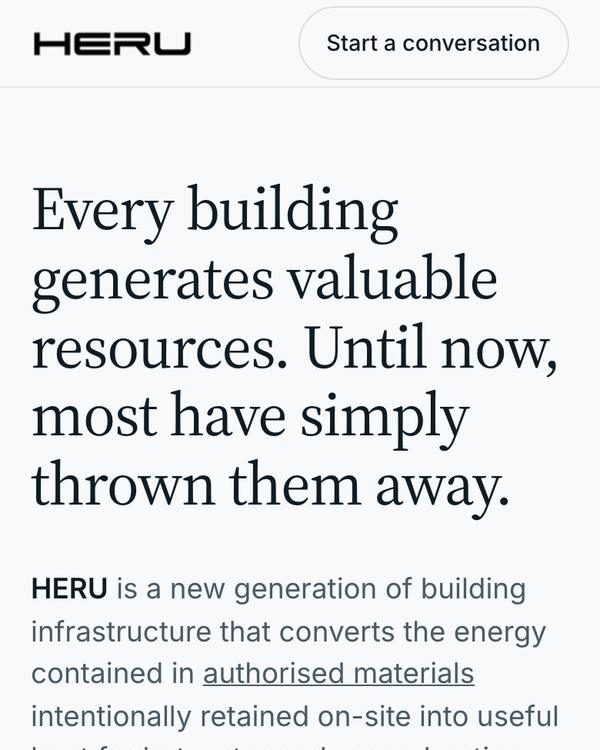
There is no food producer among my live sites yet. That is why yours is built first: you judge your own site, not a promise. The nearest match is HERU in Bidford-on-Avon: twenty-three pages, one enquiry form with eleven enquiry types, and every line held to agreed terminology.
-
Livemyheru.com
HERU
Building infrastructure, Bidford-on-Avon
-
Livestratworthadvisory.com
Stratworth Advisory
Exit planning and growth advisory, Bidford-on-Avon
-
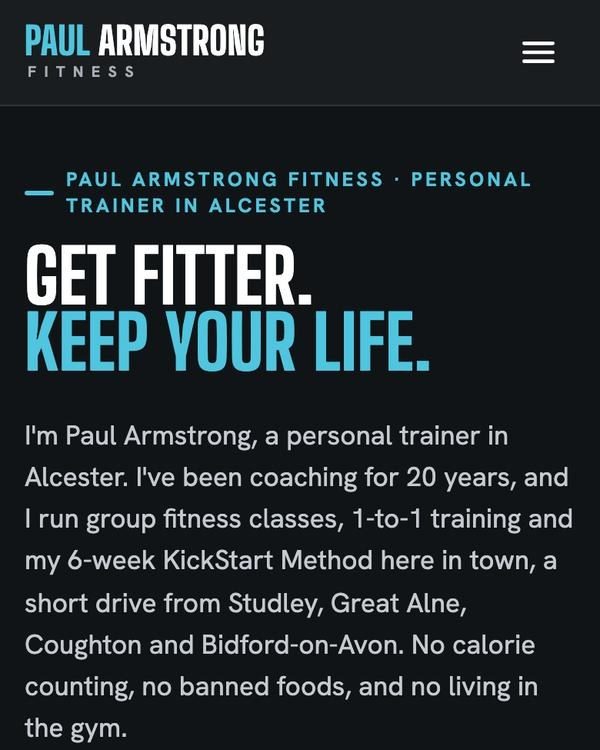
Livepaularmstrongfitness.co.uk
Paul Armstrong Fitness
Personal trainer, Alcester

“He didn’t simply build what we asked for; he understood the problem we were trying to solve and designed the website around it.”
Read it in full
Archie recently designed and built the new website for HERU Technologies, and I was extremely impressed by both the quality of the finished site and the way he approached what was a surprisingly complex brief.
One of the biggest challenges was language. HERU operates in an area where the distinction between an authorised material intentionally retained for a further purpose and something simply discarded can be important. We therefore had detailed legal and regulatory considerations behind the terminology used throughout the website. At the same time, we absolutely did not want the site to read like a legal or technical document.
Archie understood that challenge very quickly. He worked through the wording, structure and user journey so that a first-time visitor can understand what HERU is and what it does, while ensuring that the terminology remains disciplined and consistent throughout the site.
That balance between simplicity for the visitor and complexity behind the scenes was, for me, one of the strongest aspects of his work. He didn’t simply build what we asked for; he understood the problem we were trying to solve and designed the website around it.
The result is a website that represents HERU far better: clean, contemporary and easy to navigate, but with considerable thought behind what appears on the surface to be very simple communication. I would have no hesitation recommending Archie for a business looking for someone who can combine web development with genuine problem-solving.
I’ll build it first. You decide after.
Tell me the company name, what you make and roughly what scale you run at. I send you three homepage designs within a day, then build the whole website in the one you pick, every page written, usually in about 2 days, and send you a link. Look at it in your own time, and show the owner and anyone else with a say.
If you want it, it’s £650: a £162.50 deposit once you’re happy with the design, and the rest within 7 days of it going live. A bigger site, built around stock, listings or several locations, is quoted in writing before I build. If you don’t want it, say so and it comes down. You pay nothing, and I won’t follow it up.
For the owner
- Your domain (your web address, like yourbusiness.co.uk) is bought in your name, on your card. About £10 a year, paid to the company you buy it from, not to me. I send you a one-page guide to buying it.
- Already have a domain? The new site goes live on it, and your email is not touched.
- Every login is handed over in writing once it is paid for, and the hosting moves to an account in your name at no cost. Nothing is locked to me.
- No monthly fee unless you choose monthly care: £29 a month for up to five changes, stop any time.
- If you change your mind after saying yes, the 25% is kept for the work done. If I can’t get it live for a reason on my side, it comes back in full.
- You pay by bank transfer to the account named on the invoice. My bank details will never change by message.
- Your business information is kept confidential and used only to build your website. The full terms are on this site.
Already have a website? When I rebuilt Stratworth Advisory’s website, I measured both home pages the same way on the same day: the old WordPress one took 7.4 seconds to show its main content, the new one 0.8 seconds. How it was measured
What food and drink manufacturers need from a website.
The standard you are audited against, named in full and dated
A technical manager is not reading your About page. They are looking for the words BRCGS Global Standard for Food Safety, the issue you were audited to, your grade and the date of the last audit. SALSA if you are a smaller producer, SQF or IFS Food if that is what the customer works to, and HACCP underneath all of it. Put the certificate number and the expiry next to it, and swap the PDF the week you are re-audited. If you handle products of animal origin, the site’s approval number belongs there too. A certificate showing an audit from three years ago reads worse than no certificate at all, because now they are wondering what happened.
Your allergen position, written out rather than implied
This is usually the first question and it is rarely answered anywhere on the site. Say which of the fourteen declared allergens are handled on site at all, which lines are segregated, whether there is a dedicated area or not, and how changeover cleaning is validated. Say plainly where you cannot make a product free from something. A straight no in week one is worth more to a buyer than a call three weeks in. If you pack prepacked for direct sale, say you label to the requirements brought in by Natasha’s Law, full ingredient list with allergens emphasised. They are asking because it is their name on the pack as well as yours.
The capability figures a buyer checks before they bother enquiring
Capacity per shift or per week, minimum order quantity, the pack formats you run, shelf life from production, and whether you are ambient, chilled or frozen. Whether you do private label, and whether you will develop to a customer’s own specification or only sell your own range. Six numbers on one page. Without them a buyer cannot tell in thirty seconds whether you are worth an email, and a buyer who cannot tell moves to the next producer rather than asking you. The same figures stop the other half of the problem: enquiries for volumes you could never run, each one costing you half a day to turn down politely.
A product list that reads like a specification, not a gallery
For every line: pack size, case count, cases per pallet, shelf life, storage temperature, the ingredient declaration and the barcode if it is a retail pack. That is what a buyer copies straight into a listing form or a range review, and if it is not on your site they have to ask you and then wait on you. Photography still matters, but a photograph of a jar answers none of it. Give the same fields in the same order for every line, so somebody can run down the one column they care about instead of opening eleven pages to find eleven different layouts.
Traceability, and what happens when a batch has to come back
Every scheme and every serious customer wants the same thing: that you can trace one step back and one step forward, that your lot codes tie a finished pallet to the raw material that went into it, and that you have tested it rather than just written it down. Say how the coding works, how often you run a mock recall or mass balance exercise, and how quickly the last one closed. Name the role that makes the decision to withdraw, and set out the procedure in three or four sentences. It reads as dull. To somebody carrying the risk of putting your product in their pack, it is the most reassuring thing on the site.
An enquiry form that separates a buyer from someone wanting one jar
The public will find you and some of them want a single jar posted out. A buyer wants to know whether to open a technical questionnaire. Ask for the company, the channel, retail, wholesale, foodservice, export, the volume and format they are after, whether it is private label or your own brand, and any launch date they are working to. Then the message that lands already tells you which of the two it is, and the serious one can be answered the same day with the specification and the certificate attached. Put a separate line for consumer orders so those people have somewhere to go that is not the same inbox.
What usually goes wrong.
Already got a website? Check your current one
Most producers’ sites are built as a brochure for a consumer who is never going to see them.
Slow photographs of the product on a slate board, a paragraph about the founder’s grandmother, a shop with four lines in it. The buyer who arrived to work out whether you could supply forty thousand units a year leaves knowing what your bread looks like in good light and nothing else.
Where certification appears at all it is a small logo in the footer with no grade, no certificate number and no date, or a PDF from an audit two issues out of date. Silence is bad. Out of date is worse, because a technical manager now has to ask you a question neither of you wanted. Allergens are covered by the phrase “may contain”, capacity is not mentioned, minimum order quantity is not mentioned, and there is no way to tell whether you do private label or would not touch it.
Then the form. Name, email, message, going to an info@ address that nobody in technical reads. It cannot tell a category buyer from someone chasing a lost delivery, so both get the same reply two days later. Nobody is named, so a buyer with a questionnaire to send has no idea who to send it to. Half the specifications on these sites exist only as a file somebody emails out one at a time, which means every enquiry waits for one person to be at a desk.
Fair questions, answered plainly.
What food and drink manufacturers ask before they get in touch, with straight answers.
Similar businesses
Fair questions
What do buyers look for on a food manufacturer’s website?
The standard you are audited against, named in full with the grade and date, your allergen position, your capacity, minimum order, pack formats and shelf life, and a product list that reads like a specification.
Should we publish our allergen position?
Yes, written out: which of the fourteen declared allergens are handled on site, which lines are segregated, and where you cannot make a product free from something.
How do we stop enquiries from people wanting one jar?
With an enquiry form that asks for the company, the channel, the volume and format, and whether it is private label, so you can tell a buyer from a shopper before you reply.
How much does a food manufacturer’s website cost?
£0 to see it. £650 for the website built and live on your own domain: £162.50 when you say yes and £487.50 within 7 days of it going live. Or £900 with a year of changes, up to five a month. A one-page website is £350. A bigger site, built around stock, listings or a catalogue, is quoted in writing before I build.
How long does it take?
Three homepage designs within a day, then usually about 2 days to build. Then you look at it in your own time, before deciding anything. Once you say yes, it goes live within 3 working days of your last change, and within 14 days at most.
Who owns the website?
You do, once it is paid for. The domain is in your name from the start, and the hosting, the files and every login are handed over in writing.
What’s the catch?
Here is everything it can cost you. If it’s a no, nothing. If it’s a yes, 25% to go ahead: it is kept if you change your mind before the site goes live, and refunded in full if I can’t get it live for a reason on my side. The rest is due within 7 days of it going live. Your domain is about £10 a year, paid by you. Changes after it goes live are £50 for up to five, unless you have the year of changes or monthly care, and you send them to me: there is no editor to log into. And nobody can promise you a place on Google, me included.
Is there anything to sign?
Nothing to see it. If you want it, I send an order form that sets out the pages, what goes on each one and the price. A reply saying “confirmed” is enough, and no signature is needed. The terms are on this site.
yourbusiness.co.ukNot built yet
Send me your business and I’ll build it.
Your business name, what you do and where. That is enough to start. I build it, send you the link, and it costs you nothing to see it.
You deal with me, Archie Spencer. I build every site myself. I reply within 24 hours.
Said yes on a call already? You don’t need this form. Your link comes through on WhatsApp.
Got it, thank you. It has come straight to me.
I reply within 24 hours. Within a day I send you three homepage designs. Pick one and I build the whole website, usually in about 2 days. Nothing is payable unless you want it.
Got photos or a logo? Send them on WhatsApp, or email archie@archiespencer.com.
Send photos on WhatsApp