A website for your resource management firm, built before you pay for it.
Case studies with the actual figures in, and a procurement page a buyer can hand straight to their onboarding team. I build yours first, finished: £650 if you want it, a written quote first if it needs to be bigger, and nothing if you don’t.
£0 to see it finished
£650 for the website
Or WhatsApp me One message is enough to start.
 I’m Archie Spencer. I build every site myself.
5.0 on Google from 4 reviews. Read our reviews on Google (opens in a new tab)
“It's clean, looks professional and is easy to find your way around, which is exactly what I wanted.”
Real sites, live now. Open any of them.
There is no sustainability consultancy among my live sites yet. That is why yours is built first: you judge your own site, not a promise. The nearest match is HERU, where every line follows agreed terminology with legal considerations behind it, and still reads plainly.
-
Livemyheru.com
HERU
Building infrastructure, Bidford-on-Avon
-
Livestratworthadvisory.com
Stratworth Advisory
Exit planning and growth advisory, Bidford-on-Avon
-
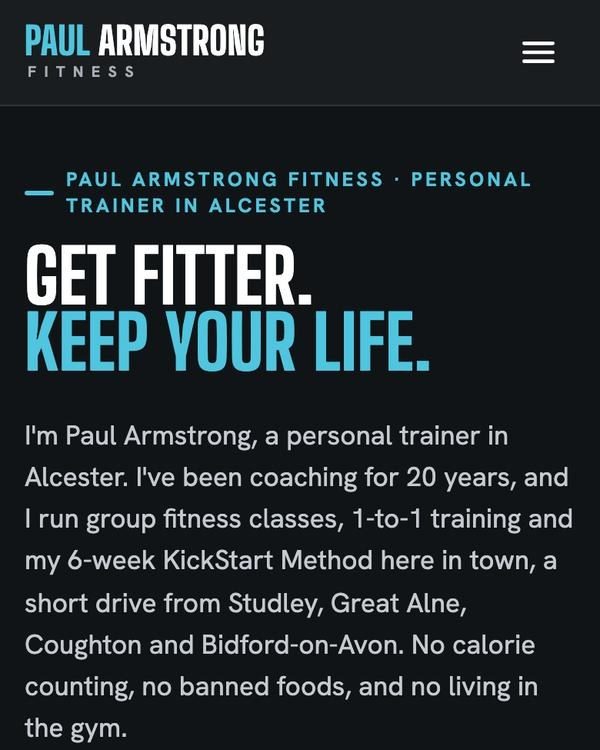
Livepaularmstrongfitness.co.uk
Paul Armstrong Fitness
Personal trainer, Alcester
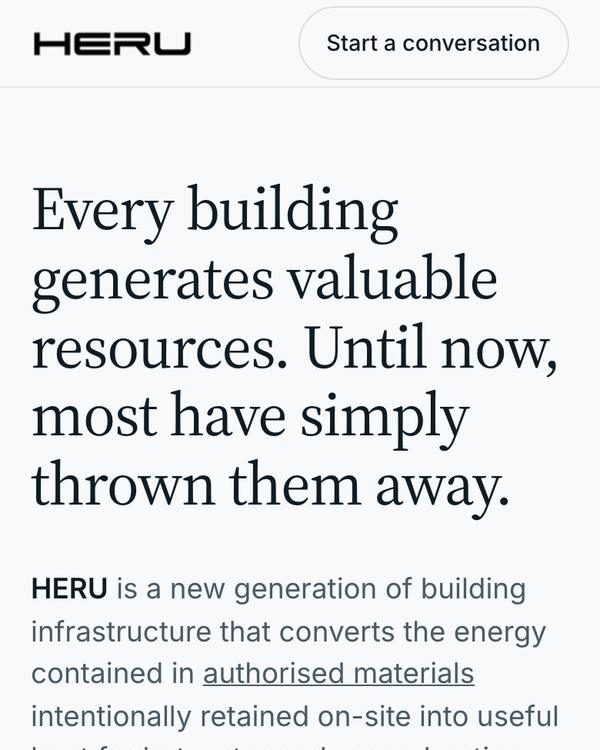

“We therefore had detailed legal and regulatory considerations behind the terminology used throughout the website.”
Read it in full
Archie recently designed and built the new website for HERU Technologies, and I was extremely impressed by both the quality of the finished site and the way he approached what was a surprisingly complex brief.
One of the biggest challenges was language. HERU operates in an area where the distinction between an authorised material intentionally retained for a further purpose and something simply discarded can be important. We therefore had detailed legal and regulatory considerations behind the terminology used throughout the website. At the same time, we absolutely did not want the site to read like a legal or technical document.
Archie understood that challenge very quickly. He worked through the wording, structure and user journey so that a first-time visitor can understand what HERU is and what it does, while ensuring that the terminology remains disciplined and consistent throughout the site.
That balance between simplicity for the visitor and complexity behind the scenes was, for me, one of the strongest aspects of his work. He didn’t simply build what we asked for; he understood the problem we were trying to solve and designed the website around it.
The result is a website that represents HERU far better: clean, contemporary and easy to navigate, but with considerable thought behind what appears on the surface to be very simple communication. I would have no hesitation recommending Archie for a business looking for someone who can combine web development with genuine problem-solving.
I’ll build it first. You decide after.
Tell me the firm’s name and the sort of organisations you work for. I send you three homepage designs within a day, then build the whole website in the one you pick, every page written, usually in about 2 days, and send you a link. Look at it in your own time, and show the owner and anyone else with a say.
If you want it, it’s £650: a £162.50 deposit once you’re happy with the design, and the rest within 7 days of it going live. A bigger site, built around stock, listings or several locations, is quoted in writing before I build. If you don’t want it, say so and it comes down. You pay nothing, and I won’t follow it up.
For the owner
- Your domain (your web address, like yourbusiness.co.uk) is bought in your name, on your card. About £10 a year, paid to the company you buy it from, not to me. I send you a one-page guide to buying it.
- Already have a domain? The new site goes live on it, and your email is not touched.
- Every login is handed over in writing once it is paid for, and the hosting moves to an account in your name at no cost. Nothing is locked to me.
- No monthly fee unless you choose monthly care: £29 a month for up to five changes, stop any time.
- If you change your mind after saying yes, the 25% is kept for the work done. If I can’t get it live for a reason on my side, it comes back in full.
- You pay by bank transfer to the account named on the invoice. My bank details will never change by message.
- Your business information is kept confidential and used only to build your website. The full terms are on this site.
Already have a website? When I rebuilt Stratworth Advisory’s website, I measured both home pages the same way on the same day: the old WordPress one took 7.4 seconds to show its main content, the new one 0.8 seconds. How it was measured
What resource management and sustainability consultancies need from a website.
Case studies with a before figure, an after figure and the method underneath
Your sector is full of sentences like “significant reductions achieved”. A procurement lead reads twenty of those in a morning and cannot separate any of them. Publish the numbers instead: tonnes of material diverted, kWh saved, tonnes CO2e, the spend avoided, the period it was measured over, and how you got from the first figure to the second. Name the sector and the scale of the site even where you cannot name the client: a 40,000 sq ft food factory, an NHS trust, a six-depot logistics operation. One engagement written up properly, with a figure a finance director could check, does more than a page of claims.
The frameworks you work to, named exactly, and what stage the client is left at
Write the standards out in full and get them right: ISO 14001, ISO 50001, ISO 14064-1, SECR, ESOS, and Scope 1, 2 and 3 under the GHG Protocol. Anyone who has sat through a certification audit stops reading at a misnamed standard. Then say what you actually leave the client holding. There is an enormous difference between a target submitted to the Science Based Targets initiative and one that has been validated by it, and between a management system built ready for audit and a certificate issued by a UKAS-accredited certification body. Say which of those you deliver, and who does the rest.
Your method and your data, written where a technical reader can check them
Whoever hires you will end up putting your numbers in front of an auditor, an investor or a group finance team, and will be asked where they came from. Put the working on the site: the reporting boundary you use, whether Scope 2 is reported location-based or market-based, which year’s DESNZ conversion factors you apply, how much of a Scope 3 figure is real supplier data and how much is spend-based estimate, and how a materials audit is actually carried out on site. It reads dry. It is the part that gets you through the second meeting, because it shows you know where your own numbers are weak.
One page per service that survives being forwarded
Your buyer is rarely the person signing. A sustainability manager finds you, then has to sell you to an operations director and a finance team who have never heard of you. Give them something to forward: one page per service with the scope, what you need from them, roughly how long it runs, what they are holding at the end, and a price basis even if that is a day rate or a range. A dated download of the same page, with the registered address on it, gets pasted into an internal paper. A vague overview page gets forwarded to nobody and you never hear why.
Who does the work, and what they are on the register for
Buying a consultancy is buying named people, and the buyer will be asked internally who they picked and why. Put the consultants up with their actual standing: Chartered Environmentalist, IEMA membership grade, Energy Institute or CIBSE registration, and whether anyone is on an approved register as an ESOS lead assessor, since an ESOS assessment has to be signed off by one. Say what each of them did before consultancy: twelve years running a plastics plant means more to a factory than any qualification does. Stock photographs of a team that is not yours reads as a firm with nobody in it.
The procurement pack, ready before the spreadsheet arrives
Past a certain client size, wanting to use you becomes a supplier onboarding exercise, and it arrives as a form. Employer’s liability, public liability and professional indemnity with the figures on them. Company number and registered address. Health and safety, environmental, modern slavery, equal opportunities, and how you handle site data under an NDA. Your own carbon figure and reduction plan, because central government contracts above a threshold require bidders to publish one and that requirement travels down supply chains. Put the lot on one page as downloads. It turns a fortnight of email into an afternoon, and it tells procurement you have done this before.
What usually goes wrong.
Already got a website? Check your current one
The sites in this sector look like each other.
A wind turbine, a green leaf, a pair of hands holding soil, and four paragraphs that would sit just as well on a competitor’s site with the name swapped over. Somewhere there is a line about being a trusted advisor on the journey to net zero. None of it tells a procurement lead anything, and it is the fifth one they have read that morning.
Then there are the claims with nothing under them. Percentages with no baseline, no period and no boundary. Zero waste to landfill with no tonnages beside it. A carbon figure with no year attached and no statement of whether Scope 2 is location-based or market-based. Case studies that give a client and an outcome and never the method. The buyer’s finance team will ask where the number came from, and if the site cannot answer that, the manager who suggested you looks careless in front of their own directors.
The third thing is that there is nothing on these sites anybody can actually use. No one-page download, no insurance certificates, no policies, no named consultants with their registrations, no price basis of any kind. So an enquiry turns into three weeks of email before anyone discusses the work, and a fair share of them never start, not because the firm was wrong, but because getting you approved internally was more effort than that manager had spare that month.
Fair questions, answered plainly.
What resource management and sustainability consultancies ask before they get in touch, with straight answers.
Similar businesses
Fair questions
What should a consultancy’s website show?
Case studies with a before figure, an after figure and the method, the standards you work to named exactly, who does the work and what they are registered for, and one page per service that survives being forwarded.
Can the website hold our procurement information?
Yes. A procurement page with your insurances, company details, policies and your own carbon figure means a buyer’s onboarding form can be answered from one place.
How much does a consultancy website cost?
£0 to see it. £650 for the website built and live on your own domain: £162.50 when you say yes and £487.50 within 7 days of it going live. Or £900 with a year of changes, up to five a month. A one-page website is £350. A bigger site, built around stock, listings or a catalogue, is quoted in writing before I build.
How long does it take?
Three homepage designs within a day, then usually about 2 days to build. Then you look at it in your own time, before deciding anything. Once you say yes, it goes live within 3 working days of your last change, and within 14 days at most.
Who owns the website?
You do, once it is paid for. The domain is in your name from the start, and the hosting, the files and every login are handed over in writing.
What’s the catch?
Here is everything it can cost you. If it’s a no, nothing. If it’s a yes, 25% to go ahead: it is kept if you change your mind before the site goes live, and refunded in full if I can’t get it live for a reason on my side. The rest is due within 7 days of it going live. Your domain is about £10 a year, paid by you. Changes after it goes live are £50 for up to five, unless you have the year of changes or monthly care, and you send them to me: there is no editor to log into. And nobody can promise you a place on Google, me included.
Is there anything to sign?
Nothing to see it. If you want it, I send an order form that sets out the pages, what goes on each one and the price. A reply saying “confirmed” is enough, and no signature is needed. The terms are on this site.
yourbusiness.co.ukNot built yet
Send me your business and I’ll build it.
Your business name, what you do and where. That is enough to start. I build it, send you the link, and it costs you nothing to see it.
You deal with me, Archie Spencer. I build every site myself. I reply within 24 hours.
Said yes on a call already? You don’t need this form. Your link comes through on WhatsApp.
Got it, thank you. It has come straight to me.
I reply within 24 hours. Within a day I send you three homepage designs. Pick one and I build the whole website, usually in about 2 days. Nothing is payable unless you want it.
Got photos or a logo? Send them on WhatsApp, or email archie@archiespencer.com.
Send photos on WhatsApp